Table of Contents
ToggleKlein power tools have built a reputation among electricians and professionals for reliability and durability, but homeowners and DIY enthusiasts are increasingly discovering their value too. While Klein isn’t the biggest name in the power tool space, that honor goes to brands like DeWalt and Makita, their focus on precision, longevity, and hand tools has earned them a loyal following. This guide walks through which Klein power tools make sense for a home workshop, how they compare to other options, and what factors matter most when choosing tools for your next project.
Key Takeaways
- Klein power tools balance professional durability with homeowner-friendly pricing, making them a practical middle-ground alternative to premium brands like DeWalt or Makita.
- Starting with a drill-driver and impact driver covers 80% of typical household projects, but adding task-specific Klein tools like jigsaws or circular saws extends capability as projects grow.
- Klein’s 18V lithium-ion battery system enables cross-compatibility across multiple tools, so investing in two higher-capacity batteries (4.0Ah) maximizes runtime and project efficiency.
- Superior build quality and low vibration design in Klein impact drivers reduce hand fatigue and improve fastening accuracy compared to budget competitors.
- Klein power tools hold 40–50% resale value on the secondhand market, making the initial investment cost-effective over time compared to disposable alternatives.
- Klein’s heritage in electrical work and professional trades since 1857 means their tools are engineered for demanding use, ensuring reliability for both occasional homeowner projects and intensive DIY work.
What Makes Klein Power Tools Stand Out
Klein’s brand identity centers on electrical work and trade tools, which shapes their entire product philosophy. They prioritize durability over flashy features. A Klein drill driver doesn’t come with sixteen lighting modes or Bluetooth connectivity: it comes with a motor that won’t quit after three years of weekend use.
One key differentiator is their heritage. Klein Tools has been making hand and power tools since 1857, primarily for electricians. That means decades of feedback from people who depend on tools to make their living. Tools built for professionals tend to handle homeowner projects without complaint.
Build quality is another strength. Klein uses stronger materials in their motor housings and chuck mechanisms compared to budget-tier brands. This translates to fewer wobbles, less slipping, and longer tool life. When you pick up a Klein impact driver versus a similar-priced option from a less-established brand, the weight distribution and balance feel noticeably better.
Klein also maintains a reasonable price-to-value ratio. They’re not the cheapest on the shelf, but they cost less than premium DeWalt or Makita systems. For a homeowner doing occasional projects, Klein tools offer a middle ground: solid performance without the premium price tag attached to brand-name power tools that double as workshop status symbols.
Essential Klein Power Tools for Homeowners
Drills and Impact Drivers
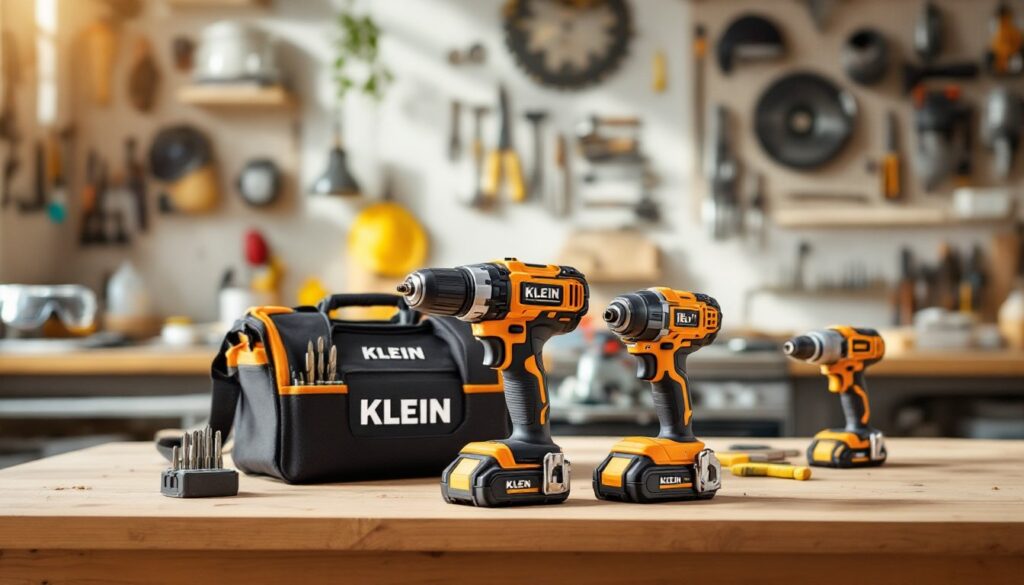
A Klein compact drill-driver (typically 12V or 18V lithium-ion) is one of the first tools worth adding to a home workshop. Drilling pilot holes, driving deck screws, and fastening cabinet hardware account for a huge chunk of DIY work, and a quality drill makes all three faster and more accurate.
Impact drivers are different animals. Where a drill applies steady rotational force, an impact driver delivers rapid rotational impacts that prevent the tool from bogging down in dense material. They excel at driving long fasteners into framing lumber or hardwood. Homeowners often ask: do I need both? For occasional projects, a single good drill-driver handles 80% of household tasks. But if you’re framing walls, building decks, or tackling multiple projects per year, an impact driver saves fatigue and time.
Klein’s impact drivers are praised for low vibration, even at full power. This matters more than it sounds. High vibration causes hand fatigue and reduces control. Cheaper impact drivers can feel like holding a jackhammer: Klein’s design keeps that in check. Battery compatibility across Klein’s lineup means you can buy one 18V system and use batteries across multiple tools as you expand your collection.
Pair any drill or impact driver with a set of bits and driver tips. A bent bit ruins the fit of fasteners and increases the risk of stripping screw heads. Klein offers organized bit sets that stay in a compact case, worth the investment over loose bits rattling around in a toolbox.
Saws and Cutting Tools
Saws are where Klein’s electrician roots show. Klein makes several cutting tools designed for cleanly slicing through materials without splintering or binding. A Klein jigsaw is excellent for curved cuts, notches around door frames, and intricate shapes. They’re lighter than circular saws but demand a steadier hand to avoid wandering off the line.
For straight cuts in lumber or sheet goods, a circular saw remains the most versatile option. Klein circular saws come in 6.5-inch and 7.25-inch blade sizes. The smaller size suits lightweight framing and trim work: the larger blade handles thicker stock and angled cuts more efficiently. The critical spec is the amp rating (usually 8 to 12 amps for Klein models). Higher amps mean the motor won’t stall when you’re pushing the blade through dense hardwood. Always wear safety goggles and hearing protection when operating any saw. A rip of 30 inches of plywood registers around 90–100 decibels, which causes permanent hearing damage over time.
Klein also builds reciprocating saws for demolition and rough cutting. A reciprocating saw isn’t for precision work, but it’s invaluable for removing old window frames, cutting through nail-embedded lumber, and rough-cutting plumbing or electrical chases. The stroke length (usually 1.125 inches for Klein models) dictates how aggressively the tool cuts. Longer strokes bite faster but are harder to control in confined spaces.
When choosing between Klein and other brands in the saw category, consider the quality of the motor and the availability of replacement blades. Klein blades are widely stocked at home centers, which means you won’t be hunting for specialized parts when a blade wears out.
Choosing the Right Klein Tool for Your Project
Start by honestly assessing your project scope and timeline. Buying a full 18V Klein system for a single shelving install is overkill. Renting tools or borrowing from a neighbor makes sense for one-off jobs. But if you’re planning multiple projects over the next few years, hanging drywall, building raised garden beds, installing trim, a foundational toolkit justifies the investment.
Next, think about battery logistics. Klein’s 18V lithium-ion batteries charge in 30 to 60 minutes depending on capacity (measured in amp-hours). If you’re working on a long project, invest in at least two batteries so one charges while you use the other. A single battery leaves you dead when it runs dry halfway through fastening a deck.
Consider the actual vs. nominal specs. A Klein “18V” tool is technically 20V under no load but drops to 18V under stress. Nominal voltage gives a clearer picture of real-world performance. Always check the amp-hour (Ah) rating on batteries: a 2.0Ah battery drains twice as fast as a 4.0Ah battery. Larger capacity costs more upfront but extends runtime significantly.
Also factor in ergonomics and personal fit. A tool that’s too heavy or has a grip that doesn’t suit your hand size causes fatigue and mistakes. Visit a home center and hold Klein models alongside competitors. Feel how the trigger responds, check the balance, and test the weight in your actual working position. A marginally heavier tool with better weight distribution beats a lighter but nose-heavy alternative.
Review what warranty Klein offers. Most of their power tools come with a 3-year limited warranty, which covers defects but not normal wear. This is standard across the industry. Keep your receipt and register the tool if Klein requires it.
Finally, think about resale value. Klein tools hold their value better than bottom-tier brands. If you outgrow your needs or upgrade to a larger system later, you’ll recover 40–50% of your investment in the secondhand market. Cheap, damaged, or proprietary tools often can’t be sold, so that “savings” actually costs you more in the long run. Homeowners using Klein power tools consistently note that the initial investment pays off through durability and ease of resale. Professional electricians often point to resources like Klein’s electrician-focused tool collections when advising homeowners on which models deliver the best bang for the buck. For broader context on building a complete home workshop, consulting guides on must-have power tools helps clarify where Klein tools fit into a larger strategy. Similarly, understanding the broader landscape of home workshop essentials ensures you’re not overspending on redundant tools or underspending on critical items. Woodworkers and general DIYers sometimes find that mechanical workshop tools complement Klein’s electrical-leaning lineup, offering alternative cutting and fastening methods for specific tasks.
Conclusion
Klein power tools deserve consideration in any homeowner’s DIY arsenal. They strike a practical balance between cost and reliability, with a proven track record in demanding professional environments. Start with a drill-driver and one quality battery, then add task-specific tools as your projects demand. Smart tool purchasing builds a workshop incrementally, avoiding clutter and keeping costs manageable. When you’re ready to move beyond basic projects, Klein scales with you.