Table of Contents
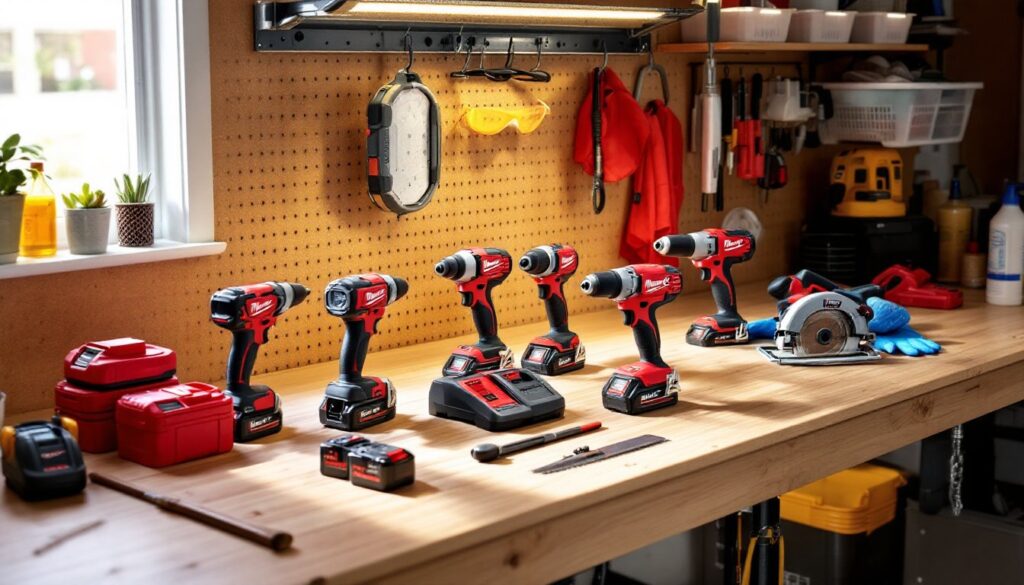
ToggleMilwaukee’s M12 tool line has become the go-to platform for homeowners and DIY enthusiasts who want serious power without the bulk and weight of full-size cordless tools. Released in 2007, the compact M12 system delivers genuine performance in a form factor that doesn’t fatigue your arms on a ladder or leave your toolkit looking like a contractor’s truck bed. If you’re tackling interior projects, hanging shelves, assembling furniture, or doing general home maintenance, M12 tools hit the sweet spot between portability and stopping power. This guide covers the must-have models, what each one does best, and why the system makes sense for your workshop in 2026.
Key Takeaways
- Milwaukee M12 tools deliver genuine cordless power in a compact, lightweight design that balances portability with performance for DIY homeowners and interior projects.
- The M12 battery ecosystem is interchangeable across dozens of tools, meaning you buy batteries once and swap them between drills, impact drivers, saws, and other compatible tools.
- M12 drill-drivers and ¼-inch impact drivers are the foundational tools to start with, handling fastening, drilling, and fastener removal for trim work, cabinetry, and assembly tasks.
- M12 saws and oscillating multi-tools excel at interior finishing work, cutting drywall, plywood, and trim with less mess than full-size alternatives.
- M12 tools cost less per tool than competitor brands and weigh significantly less than M18 equivalents, making them ideal for ladder work and building a diverse, budget-friendly workshop.
- Start with an M12 drill-driver and impact driver, add cutting tools as projects demand, and you’ll have a practical toolkit that handles 90% of interior home maintenance and renovation work without contractor-grade bulk.
What Are Milwaukee M12 Tools?
The Milwaukee M12 platform is a dedicated line of compact lithium-ion cordless tools built around the M12 battery ecosystem. Unlike general “compact” tools that compromise power, M12 devices are purpose-engineered to deliver full capability at 12 volts, enough for serious work on trim, fastening, drilling, and demolition tasks.
The M12 system uses interchangeable Milwaukee RedLithium batteries (ranging from 1.5Ah to 4.0Ah), which means one battery pack works across dozens of compatible tools. This shared ecosystem is a genuine time-saver: you buy batteries once, then swap them between drill-drivers, impact drivers, oscillating tools, and saws. Battery run-time varies by amp-hours and tool load: a 2.0Ah pack might give you 15–30 minutes of continuous drilling, while a 4.0Ah pack extends that to an hour or more.
Milwaukee prices M12 tools below their larger M18 and M28 cousins, making them budget-friendlier for DIY work. They’re also lighter, crucial when you’re on a ladder, and take up less drawer space. If you’re building a home workshop from scratch, M12 is where most DIYers start.
Power Drills and Drivers
The drill-driver is the workhorse of any cordless toolkit. Milwaukee M12 drill-drivers come in two main flavors: the standard ½-inch chuck models for general drilling and driving, and the lighter ³⁄8-inch compact drills for tight spaces.
The M12 ½-inch drill-driver (model 2402-20, tool-only) delivers 300 unit watts output and 1,500 RPM. It’ll handle hardwood, softwood, drywall, and light metal drilling without stalling. Torque is sufficient for driving ⅜-inch lag screws and ½-inch fasteners into framing lumber. Run-time on a 2.0Ah battery is roughly 30 minutes of mixed drilling and driving: jump to 4.0Ah and you’re closer to 60 minutes.
For jobs where you’re reaching into wall cavities, under sinks, or inside cabinets, the compact ³⁄8-inch models shine. They weigh about 2.4 pounds (versus 3.2 pounds for the half-inch) and fit where fat chucks don’t.
When comparing to full-size 18V drills, M12 models spin slower and drive lighter fasteners, but they’re fast enough for trim work, cabinetry, and interior finish carpentry. If you’re regularly driving 1-inch+ deck screws into pressure-treated lumber or boring large-diameter holes in structural beams, step up to M18, M12 can do it, but you’ll notice the pace.
Speaker’s choice: pair an M12 drill-driver with a Workshop Tools List guide to identify what else your setup needs.
Compact Drill-Driver Models
Milwaukee offers several M12 drill-driver variants. The M12 ½-inch single-speed runs at fixed 1,500 RPM, best for general work. The two-speed model toggles between 0–450 RPM (low, high-torque mode) and 0–1,500 RPM (high-speed), letting you creep in fasteners or spin out hole saws without breaking your wrist. Two-speed models cost $15–25 more but pay for themselves in control and reduced cam-outs.
Batteries matter: a 2.0Ah RedLithium charges in under 30 minutes (using the M12 charger), while a 4.0Ah takes 60 minutes. The larger pack adds about $50 to your kit cost but extends run-time significantly, which is worth it if you’re doing a whole-house project. Consider buying two batteries so one charges while you work with the other.
Impact Tools for Heavy-Duty Tasks
An impact driver is different from a drill. It drives fasteners using rotational impacts, thousands of micro-jolts per second, rather than steady torque. This means less wrist strain, better fastener seating, and ability to drive long screws that’d stall a regular drill.
The Milwaukee M12 ¼-inch hex impact driver (model 2401-20) is the star. It delivers 1,500 inch-pounds of rotational torque at 2,500 impacts per minute. That’s enough to drive ⅜-inch lag bolts, 3-inch wood screws, and concrete fasteners into masonry anchors (with appropriate bits). Weight is a hair over 1.5 pounds, making it genuinely one-handed for light fastening.
Impact drivers excel at fastener removal too. If you’re disassembling a fence, deck, or old shelving, the impact action breaks corrosion and prevents bit cam-out. Pair it with a quality 1-inch Phillips or square-drive bit (not the flimsy hardware-store stuff) and you’ll save hours versus a regular drill on deconstruction work.
For true heavy work, driving ½-inch structural bolts or fastening into doubled-up framing, an M18 impact is worth the upgrade. But for interior drywall anchors, cabinet assembly, and deck railing fasteners, M12 impact is overkill in the best way.
Wear safety glasses always when using impact tools: ejected bits or fastener pieces move fast. Gloves are optional on impact drivers, unlike older drill-chucks where loose sleeves can snag. If you’re wearing a wrist watch or bracelet, remove it before using any rotating tool.
Saws and Cutting Tools
Milwaukee’s M12 saw lineup includes oscillating multi-tools, circular saws, and reciprocating saws, though the recip saw sits at the edge of M12’s practical range.
The M12 oscillating multi-tool (model 2426-20) uses a ⅛-inch stroke at up to 11,000 oscillations per minute. It’ll cut drywall, plywood, trim, nails, and PVC without the mess of a full-size circular saw. The quick-change head accepts standard Fein-style blades: wood-cutting, metal-cutting, and aggressive grout-removal blades. Run-time is roughly 30–45 minutes on a 2.0Ah battery. This tool is genuinely useful for interior trim-out, demolition, and retrofit work. If you’re doing kitchen or bathroom remodeling, you’ll use this weekly.
The M12 circular saw (3-⅜-inch blade, model 2530-20) is compact and ideal for crosscutting 2×4 lumber and plywood edge-trimming. Blade speed is 5,800 RPM, which is adequate but not screaming-fast: expect slightly rougher cuts than a full-size saw, especially on hardwoods. The shoe plate bevel goes to 50 degrees. For light framing and trim work, it’s solid: for repetitive ripping or production work, step up to a full-size M18 or corded saw.
The M12 reciprocating saw (model 2445-20, 11-16 TPI blade) can hack through nail-embedded lumber, copper pipe, and aluminum, but its shorter 5/8-inch stroke and lower speed (3,000 SPM) make it slower than M18 reciprocating saws. Use it for tight-quarters demolition, cutting out a section of rim joist or facia board, not for bulk deconstruction.
If you’re doing major cutting, Must-Have Power Tools for Home Workshop for a broader tool review. Always wear dust masks and eye protection when cutting drywall, wood, or concrete dust: respiratory hazard is real.
Why Choose Milwaukee M12 for Your Workshop
Milwaukee M12 tools excel because they solve a genuine problem: full-size cordless tools are overkill for interior projects, yet corded tools and manual hand tools slow you down. M12 strikes the balance.
Battery ecosystem is the killer feature. One 4.0Ah battery ($40–60) powers your drill, impact driver, oscillating multi-tool, and flashlight. You’re not buying separate batteries for each brand. Compare that to older cordless systems where every tool needed its own pack, expensive and space-consuming.
Portability matters more than DIYers expect. A full-size 18V drill weighs 3.6 pounds: M12 weighs 2.4 pounds. Multiply that across four tools and an 8-hour project on a ladder, and your shoulders know the difference. Contractors and handypeople recognize this, many carry both M12 and M18, using M12 for interior work and M18 for structural framing or site work.
Cost-per-tool is lower than name-brand compact competitors. A bare M12 drill-driver ($60–80) undercuts equivalent DeWalt or Makita compacts. If you’re on a budget or just starting out, M12 lets you buy more tools for less money.
Brand reliability counts. Milwaukee tools carry a 5-year warranty and are backed by a robust parts and service network. If your drill fails two years in, you can find service centers in most metros.
That said, M12 isn’t right for everyone. If you’re a professional running job sites, the slower speeds and lighter fastener capacity of M12 versus M18 will frustrate you. If you’re doing rough framing or demolition daily, M18 or corded tools are faster. But for homeowners, DIY renovators, and folks building a diverse toolkit, M12 is the sweet spot. Resources like Today’s Homeowner and Family Handyman recommend M12 platforms for exactly this reason.
Consider also the Must-Have Power Tools for Home Workshop guide for an integrated view of how M12 fits alongside other essential workshop equipment. When you’re planning your toolkit, start with M12 drills and impacts, add one or two saws based on your project scope, then expand as needed. You’ll build a practical, versatile setup without the clutter or expense of a full contractor’s arsenal.
Conclusion
Milwaukee M12 tools are a proven, practical choice for DIY home projects. They offer genuine power, battery interchangeability, and reasonable cost without the bulk of full-size systems. Start with a drill-driver and impact driver, add a saw or oscillating multi-tool when the project demands it, and you’ll have a toolkit that handles 90% of interior home maintenance, assembly, and light renovation work. Build smart, stay safe, and reach for M12 when cordless performance meets portability.