Table of Contents
ToggleIf you’ve spent the last few years watching budget cordless drills die mid-project, you’re not alone. DeWalt XR tools represent a jump in performance that matters for serious DIY work. The XR designation means extended runtime and amp-hour capacity, tools built to handle real jobs without constant battery swaps. Whether you’re framing a deck, driving hundreds of fasteners, or running a weekend renovation, these tools deliver the kind of reliability that makes work feel less like a chore. This guide walks through what XR technology actually does, which models earn their shelf space, and whether the investment pays off for homeowners who tackle more than casual fixes.
Key Takeaways
- DeWalt XR tools feature higher-capacity lithium-ion batteries (5.0 Ah or larger) that deliver 50% more runtime than standard models, eliminating frequent battery swaps on serious DIY projects.
- XR technology combines brushless motors, smart battery management, and voltage stability to maintain power under load, making these tools ideal for demanding tasks like framing decks or driving large fasteners into hardwood.
- Entry-level DeWalt XR drills like the DCD777 cost $99–150 and offer reliable performance, while advanced models like the DCD995 with two-speed transmissions justify higher upfront costs through durability and resale value.
- Investing in a second XR battery ($80–120) and pairing it with a rotation charging strategy eliminates downtime and is one of the most cost-effective upgrades a DIYer can make.
- Impact drivers like the DCF899 complement XR drills by handling tight or stripped fasteners with rotational torque, reducing hand fatigue on deck work, cabinetry, and structural projects.
- Genuine DeWalt XR batteries hold 80% capacity after 3 years of regular use, while buying kits during seasonal sales (December–January or September–October) can reduce costs by 20–30% compared to full-price purchases.
What Are DeWalt XR Tools and Why They Matter
DeWalt XR tools use higher-capacity lithium-ion batteries, typically 5.0 Ah (amp-hours) or larger, compared to standard models that usually top out at 2.0 to 3.0 Ah. More amp-hours mean longer runtimes before you reach for the charger. A typical 5.0 Ah XR battery delivers 50% more work per charge than a standard 3.0 Ah pack, though actual runtime depends on the tool and load.
The “extended runtime” isn’t marketing fluff, it’s the difference between finishing a project in one session versus breaking for charging. For deck building, cabinet installation, or drywall hanging, battery life directly affects workflow. You’re not swapping packs, waiting for the charger, or leaving a job half-done. XR batteries also maintain voltage under load better than older designs, which means the drill stays powerful even as the battery drains. That matters when driving 3-inch screws into hardwood or drilling into masonry.
Key Features of DeWalt XR Technology
Brushless Motors: XR tools pair high-capacity batteries with brushless motor designs. A brushless motor has no carbon brushes to wear out, so it runs cooler, lasts longer, and converts more battery power into actual work instead of heat loss. You’ll feel the difference in sustained performance during long jobs.
Smart Battery Management: XR batteries include fuel-gauge LEDs showing remaining charge at a glance. The battery management system protects against over-discharge and thermal runaway, real safety features that extend battery life to 3+ years of regular use. Cheaper aftermarket batteries often skip this protection.
Compact Yet Powerful: Don’t confuse XR with bulky. Many XR drills weigh under 4 pounds, so you can work overhead or in tight spaces without fatigue. A DeWalt DCD777D2 Compact Drill delivers 300 unit watts out (UWO) in a tool light enough for one-handed operation.
Compatibility: XR batteries work across DeWalt’s 20V system. If you own an XR impact driver, that battery slides into an XR drill, grinder, or reciprocating saw. Building a tool ecosystem around one battery platform cuts costs long-term.
Top DeWalt XR Tool Models for Home Projects
Cordless Drill and Driver Options
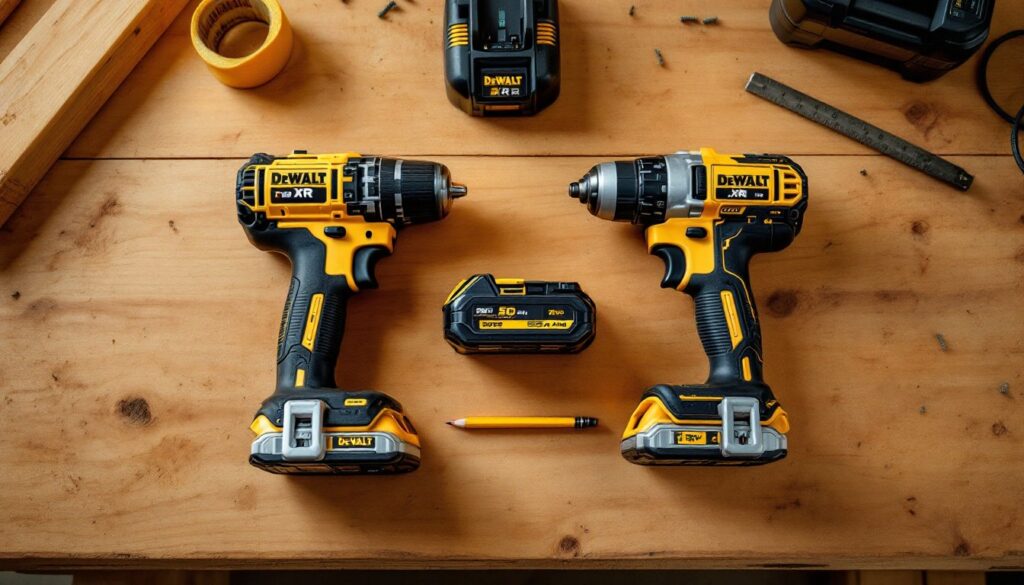
The DCD791C2 and DCD777C2 are entry points to XR performance at reasonable cost. Both use 20V XR batteries and brushless motors. The DCD791 is lighter (3.6 pounds) for overhead work: the DCD777 offers more torque for larger fasteners. Neither is premium-tier, but both outlast budget imports from big-box stores.
For serious work, framing, dense hardwoods, or sustained use, the DCD995 or DCD996 step up with increased power, two-speed transmissions (0-450 or 0-1,500 RPM), and better ergonomics. They accept up to 6.0 Ah batteries, so you’re not battery-limited on a full day’s work. These cost more upfront but run circles around consumer-grade drills and hold resale value.
A two-speed transmission matters more than specs suggest. Low speed gives you torque for tough jobs: high speed handles lightweight fasteners and drilling quickly. If you’re drilling lots of pilot holes or driving finish screws, high speed saves time.
Impact Drivers and Compact Solutions
Impact drivers deliver rotational and concussive force, perfect for tight or stripped fasteners that a drill won’t budge. The DCF885 or DCF887 are compact, lightweight XR impact drivers under 4 pounds. They excel at deck work, fence installation, and cabinet assembly where speed and power matter but size does.
The DCF899 1/4-inch compact impact is genuinely compact, smaller than a paint can, yet delivers 1,500 inch-pounds of rotational torque. Tight spaces, awkward angles, and overhead work (shelving, trim, cabinetry) suit it perfectly. One-handed operation is realistic even when tired.
For automotive work, structural bolts, or lag screws, professional contractors often turn to impact drivers because they reduce hand fatigue and cam-out (the tool slipping off the fastener). DIYers doing occasional automotive work or serious carpentry benefit from an impact driver in the toolkit. Pair it with an XR battery and you’ve got a workhorse.
Battery Life and Power Performance Expectations
A 5.0 Ah XR battery driving 3-inch deck screws into pressure-treated lumber delivers roughly 2.5–3.5 hours of intermittent work before the fuel gauge dips below 25%. “Intermittent” is the key word, you’re not drilling continuously: you’re drilling, moving, positioning, then drilling again. Real projects involve lots of idle time.
In continuous operation, say, drilling 100 pilot holes in succession, expect 45 minutes to 1 hour from a 5.0 Ah pack in a compact drill. Impact drivers drain batteries faster because they work harder per strike. Runtime varies by load: tight fasteners eat battery faster than loose ones.
Charging time matters for workflow. The standard DeWalt charger takes 30–60 minutes for a 5.0 Ah pack, depending on model. If you own two packs and rotate them, you’re never waiting. Investing in a second XR battery ($80–120) is one of the smartest moves a serious DIYer can make, it costs less than a professional contractor’s hourly rate and eliminates downtime.
Battery longevity is real. DeWalt XR packs hold 80% capacity after 3 years of regular use if you follow basic care: don’t leave them in extreme heat or cold, charge fully before long storage, and use the correct charger. Cheap knockoff batteries fail in months. Genuine packs cost more upfront but last and hold voltage better.
Cost Considerations and Value for DIY Enthusiasts
A single compact XR drill (DCD777 or DCD791 equivalent) runs $99–150 with one battery and charger. Entry-level tools at big-box retailers may cost $80 but use cheaper motors and weaker batteries that die in 2–3 years. XR tools cost 25–40% more but hold up and resell better.
Building a practical toolkit, a drill, impact driver, and reciprocating saw on the same battery system, means spending $300–500 total for quality gear. Compare that to renting a tool for a weekend ($30–60 per tool) or buying cheap cordless imports that end up in the trash after two seasons. If you’re doing any home improvement beyond painting and hanging shelves, owning beats renting.
Battery ecosystem costs are worth considering. Two 6.0 Ah XR batteries and a dual charger add another $200–250 but solve battery anxiety on any job. You’re building redundancy, which is how professionals work. DIYers often underestimate how many batteries make sense: two is minimum if you work regularly.
When comparing prices, factor in warranty. DeWalt offers a 3-year limited warranty on tools and a 3-year limited warranty on batteries if purchased with the tool. Some retailers offer extended protection plans for $15–30 per tool. For a serious DIYer buying their first kit, basic extended coverage on batteries is worth the cost, it covers manufacturing defects and accidental damage without documentation.
Market pricing fluctuates seasonally. Spring and early summer (March–June) see higher prices: post-holiday sales (December–January) and fall clearance (September–October) offer discounts. Buying a complete kit during sale events can drop the cost 20–30% versus buying piece by piece full-price. Sites like CNET regularly review power tool deals and can flag seasonal pricing trends.